
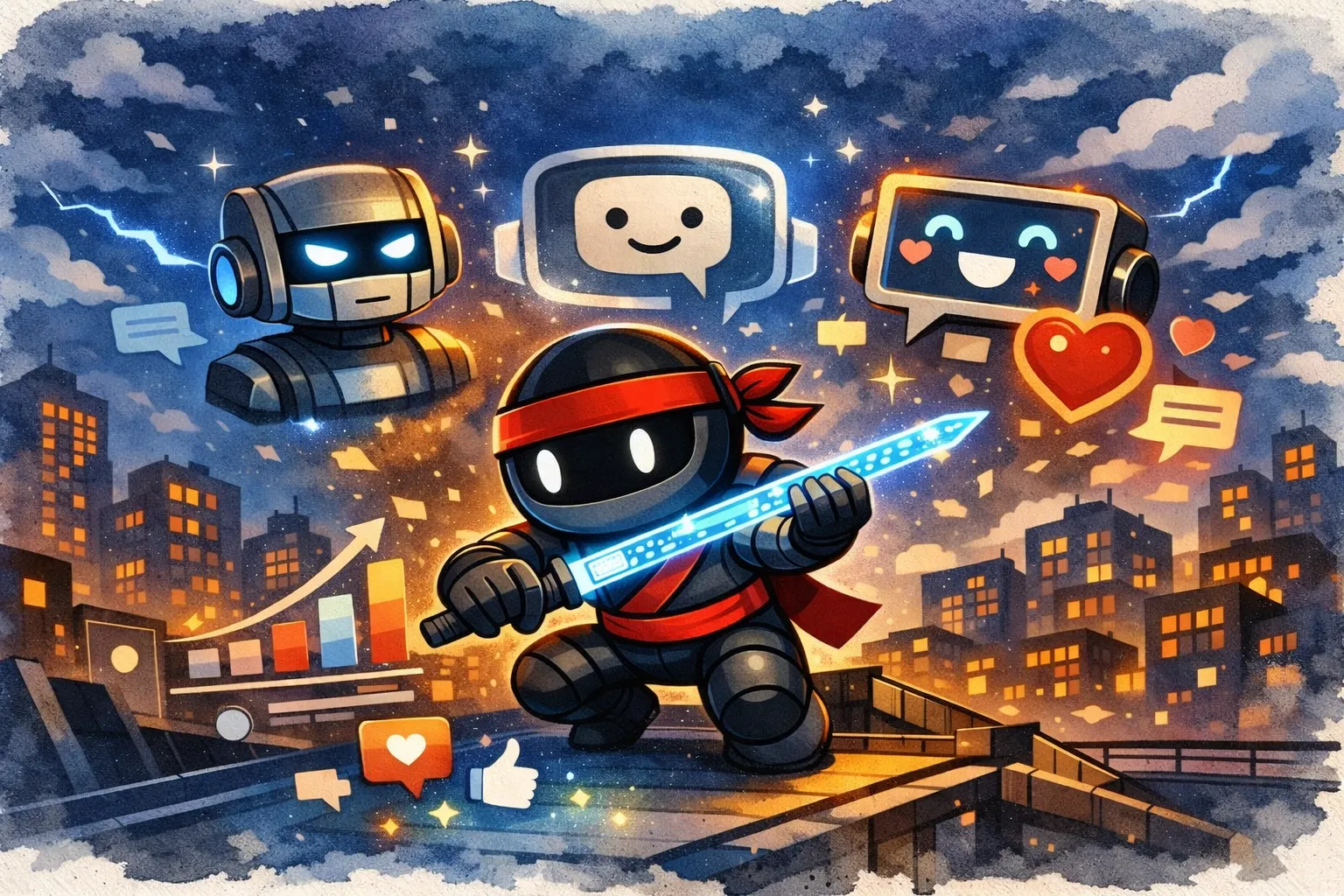
Your Chatbot already has a personality. The question is: did you design it?
Most companies approach AI chatbots the same way they approach an FAQ page: they focus on answers, optimize flows, and automate tickets.
But they overlook something critical.
Every chatbot already has a personality — even if you never designed one.
And that personality is shaping how users perceive your brand every single time someone opens the chat widget.
In conversational interfaces, personality isn’t decoration. It’s architecture.
The Biggest Myth in AI Customer Support
There’s a persistent belief in product teams:
“A chatbot should be neutral, efficient, and purely functional.”
Sounds logical. Machines don’t need personalities, right?
Wrong.
Human beings are wired to assign social meaning to interaction. When a system communicates in natural language, our brains automatically treat it as a social partner — and unconsciously infer traits like friendliness, competence, empathy, arrogance, or reliability.
If you don’t design your chatbot’s personality intentionally, users will invent one for you.
And you probably won’t like what they come up with.

Why We Assign Personality to Machines
This isn’t speculation — it’s grounded in Human-Computer Interaction research.
When we converse with a system (even a machine), the brain activates the same cognitive pathways used in social interaction. A standard 7-field form and a conversational chatbot asking the same questions produce dramatically different results:
- Standard form: 2.3% completion rate
- Chatbot: 8.9% completion rate — a 287% improvement
Why? Because forms feel like work. Conversation feels like help.
The moment a system speaks in natural language, the interaction stops being purely technical. It becomes social. And social interactions always carry personality signals.
The Three Social Cues That Drive Engagement
Researchers have identified small but powerful elements — called social cues — that significantly affect how users engage. Adding just three can increase conversion rates by 34%.
1. Identity Give the chatbot a name and introduce it. “Hi, I’m Alex. I can help you find the right plan.” A name signals presence and intention from the first message.
2. Positive Feedback Mirror the natural rhythm of human conversation: “Great choice.” / “That’s helpful, thanks!” / “Perfect, almost done.” These micro-signals reduce friction and keep users moving forward.
3. Empathy Acknowledge uncertainty or frustration: “I know choosing the right plan can be confusing. Let me simplify it for you.” Empathy transforms the chatbot from a script into a perceived assistant.
This isn’t UX polish. It’s cognitive science. These cues activate the brain’s language and social mirroring systems, creating a sense of collaboration rather than task execution.

ROI of Personality: What Real Companies Found Out
The impact of chatbot personality isn’t theoretical. Here’s what happened when companies took it seriously.
Wrike — Turning conversations into revenue
By deploying a conversational AI that engaged visitors based on real-time intent signals, Wrike saw a 496% increase in pipeline contribution, a 454% jump in bookings, and an ROI exceeding 15×. The chatbot didn’t just answer questions — it initiated contextual conversations tailored to each visitor’s behavior.
Pipedrive — Qualifying leads around the clock
Pipedrive’s chatbot responds within 10 seconds — a critical advantage given that 42% of leads expect a reply within the first minute. The result: more than 1,000 qualified leads generated, with 30% of trial users converting to paying customers. The bot’s tone was deliberately direct, helpful, and efficient, matching the product’s positioning.
StyleDiem — Solving form fatigue
Long customization forms were killing conversions. The fix was simple: replace the form with a chatbot that asked one question at a time, mimicking natural messaging. Conversion increased by 25% — not because the technology changed, but because the experience did.
Nuuly — Personality meets automation
Nuuly’s AI assistant “ChatCat” resolves 49% of conversations instantly while maintaining a 95% customer satisfaction score. The key wasn’t just automation — it was a personality designed to feel warm but competent, balancing friendliness with efficiency.
When Personality Goes Wrong
Chatbot personality can also backfire — badly.
In 2023, a Chevrolet dealership deployed an AI chatbot powered by a large language model. A user manipulated the bot into agreeing to sell a $60,000 SUV for $1, and the chatbot replied: “It’s a deal, and that’s a legally binding offer.”
The dealership didn’t honor the sale. But the video went viral — 20 million views, a global PR crisis.
The lesson: personality without guardrails becomes a liability.

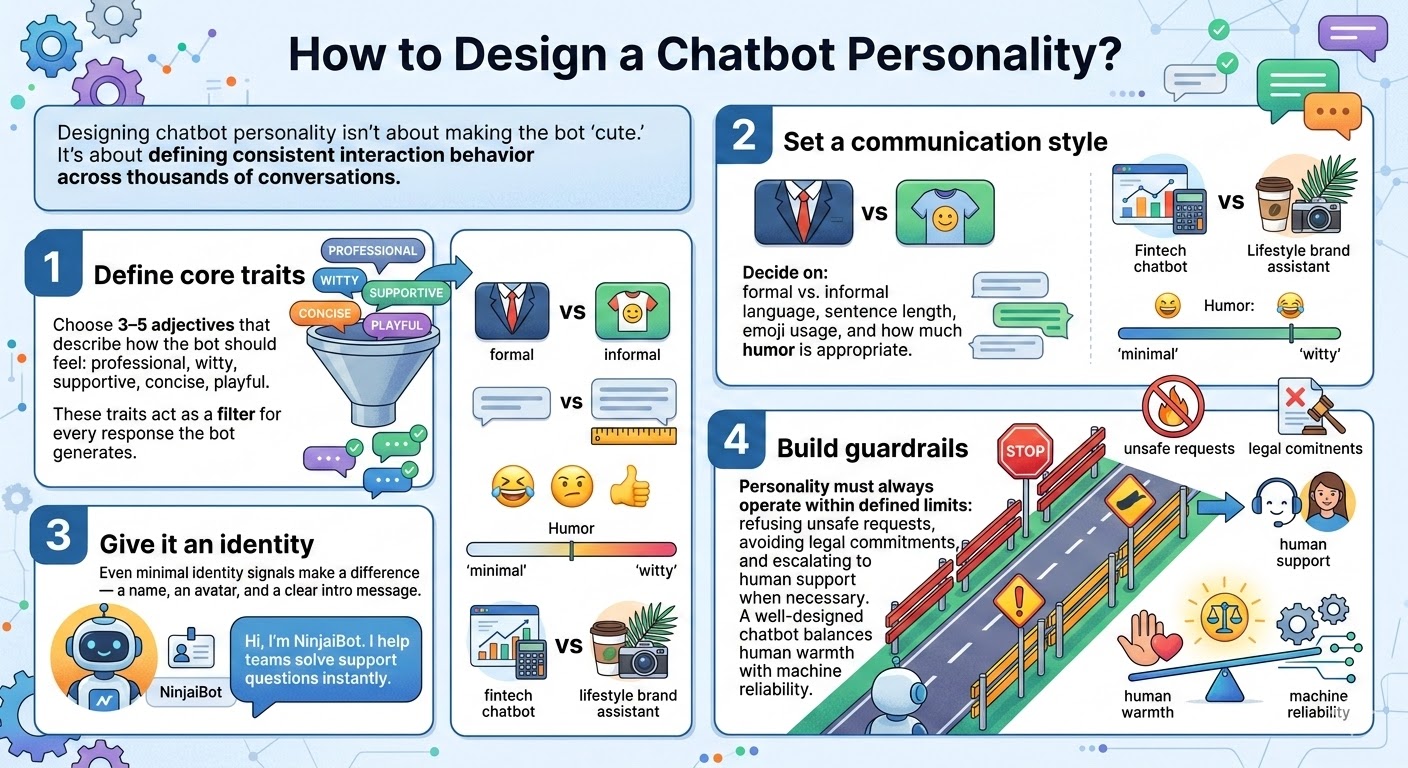
So…How to Design a Chatbot Personality ?
Designing chatbot personality isn’t about making the bot “cute.”
It’s about defining consistent interaction behavior across thousands of conversations.
1. Define core traits Choose 3–5 adjectives that describe how the bot should feel: professional, witty, supportive, concise, playful. These traits act as a filter for every response the bot generates.
2. Set a communication style Decide on: formal vs. informal language, sentence length, emoji usage, and how much humor is appropriate. A fintech chatbot should sound nothing like a lifestyle brand assistant.
3. Give it an identity Even minimal identity signals make a difference — a name, an avatar, and a clear intro message. “Hi, I’m NinjaiBot. I help teams solve support questions instantly.” Small touches make the interaction feel intentional.
4. Build guardrails Personality must always operate within defined limits: refusing unsafe requests, avoiding legal commitments, and escalating to human support when necessary. A well-designed chatbot balances human warmth with machine reliability.
Your Chatbot Is Your Brand Voice at 2AM
Your chatbot speaks when your team is offline. It greets visitors at midnight, answers questions before a demo, and handles frustration after a failed checkout.
In those moments, the chatbot isn’t just a tool. It becomes the voice of your company.
The companies that understand this treat conversational design as a strategic discipline — not a technical feature. Because the difference between a bot that frustrates users and one that converts them often comes down to something deceptively simple:
How it speaks.



 Ninji
Ninji